

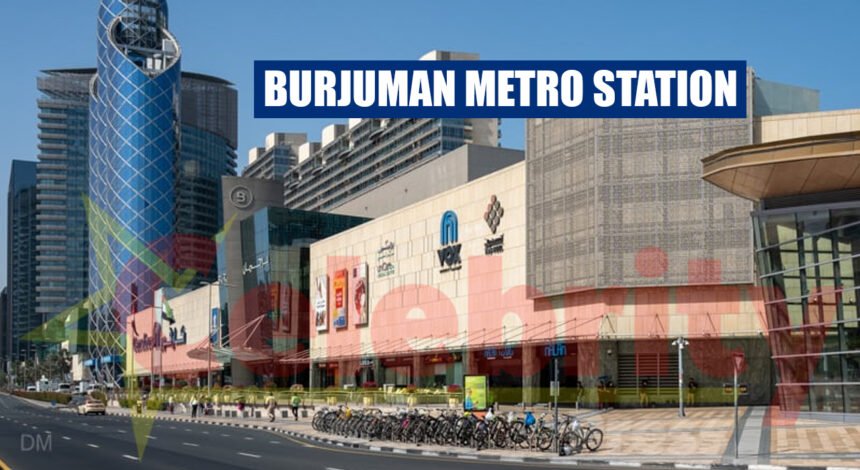
BurJuman Metro Station is a genuine, well-documented interchange station on the Dubai Metro, serving as one of only a small number of stations where the Red Line and Green Line meet, allowing passengers to transfer between the two lines without leaving the station. Unlike many of the terms covered elsewhere in this series, this is a real place with an independently verifiable Wikipedia entry, official Roads and Transport Authority documentation, and a substantial, largely accurate content cluster describing it.
The Basic Facts
BurJuman Metro Station is located underground in the Bur Dubai area, positioned below the intersection of Sheikh Khalifa Bin Zayed Street and Khalid Bin Al Waleed Road. It opened on 9 September 2009 as one of the original stations on the Dubai Metro network, initially under the name Khalid Bin Al Waleed before being renamed BurJuman, reflecting its proximity to the BurJuman shopping mall and business complex.
Why It’s an Especially Important Station
BurJuman serves as a key interchange point between the Red Line, which runs along Dubai’s main coastal corridor connecting the airport, downtown, and the Marina area, and the Green Line, which serves older, more central parts of the city including Deira and Bur Dubai’s historic districts. With over 15.6 million passengers recorded since opening, BurJuman ranks as the second-busiest station on the entire Dubai Metro network, a genuinely significant transit hub rather than a minor or obscure stop.
What’s Nearby
The station sits close to BurJuman shopping mall, a major retail and business complex, as well as several foreign consulates, including those of Canada, Egypt, India, and the United Kingdom, and the historic Al Seef waterfront district along Dubai Creek, making it a practical arrival point for both commuters and visitors headed to any of these destinations.
Bus and Wider Transit Connections
Beyond its role as a metro interchange, BurJuman connects to numerous Roads and Transport Authority bus routes, including lines 21, 29, 33, 44, 61, 66, 67, and 91 among others, extending its reach to destinations across Dubai including The Dubai Mall and Jebel Ali, making it a genuinely significant multi-modal transit hub rather than simply a metro-to-metro transfer point.
The Content Cluster Around This Term
A number of dedicated and general travel sites, including PropertyFinder, Dubai-Online, burjumanmetrostation.com, DubaiMetroRails, stations.ae, dubaimetrolineae.com, and kayfuae.com, all publish detailed guides to the station, covering timings, fares, and nearby attractions. Unlike many other cases in this series, the core factual claims across this cluster, the station’s lines, location, and interchange function, are consistently accurate and align with the independently verifiable Wikipedia entry and official Dubai Metro documentation.
Why Multiple Domains Still Appear Even for Accurate Content
The presence of several differently branded websites covering the same transit station, some appearing to be dedicated single-purpose domains built specifically around this one station’s name, reflects the same search-traffic-driven content production pattern documented throughout this series, even though, as with Pyntekvister covered elsewhere, the underlying factual content in this specific case holds up well to independent verification.
Comparing BurJuman to Other Real-Place Cases
| Factor | Genuine verifiable claim | BurJuman content cluster |
|---|---|---|
| Existence as a real place | Confirmed via Wikipedia, official RTA sources | Consistently confirmed |
| Line and interchange information | Red and Green Line interchange | Accurately and consistently described |
| Opening date | 9 September 2009 | Consistently cited across sources |
| Passenger volume claim | 15.6 million+ since opening, second-busiest | Consistently cited, matches independent source |
What Makes This a Low-Risk, High-Confidence Case
BurJuman Metro Station involves no security risk, no financial risk, and no invented product or service being marketed under false pretenses. It’s simply a real, significant piece of public transit infrastructure that happens to be covered by a search-traffic-oriented content cluster, similar in structure to less accurate cases in this series but without the underlying factual problems that usually accompany that structure.
Comparing BurJuman to Other Major Interchange Stations Worldwide
Major transit interchange stations in large cities worldwide, from London’s King’s Cross St Pancras to New York’s Times Square-42nd Street, tend to share BurJuman’s basic characteristics: high passenger volume, proximity to significant commercial or cultural landmarks, and a role as a genuine multi-line transfer point rather than a single-line stop, placing BurJuman within a recognizable and well-understood category of urban transit infrastructure rather than anything unusual for a city of Dubai’s scale and ambition.
A Practical Note for Visitors
For anyone actually planning to use BurJuman as a transit point, arriving with a valid Nol card, Dubai’s contactless transit payment card, is the standard and most convenient way to access the Dubai Metro system, and checking current RTA fare and schedule information directly through the official Dubai Metro or RTA channels is more reliable than relying on any single third-party guide site, official or otherwise, for time-sensitive details like fares or service changes.
Why Checking Official Sources Still Matters Even Here
Even for a well-documented, accurately covered real place like BurJuman, checking the official Roads and Transport Authority website or app for current fares, timings, and any service disruptions remains the most reliable approach, since third-party guide sites, even accurate ones, may not reflect the most recent fare adjustments or schedule changes.
The Renaming History Worth Knowing
BurJuman’s original name, Khalid Bin Al Waleed, referencing the road beneath which it sits, was changed to reflect the adjacent shopping mall’s name, a naming pattern also seen at other Dubai Metro stations where a station’s commercial sponsor or a prominent nearby landmark provides the more commonly used public name, worth knowing if older references or maps still use the original station name.
Why This Case Is a Useful Contrast for This Series
BurJuman Metro Station provides a useful contrast to the more commonly debunked or distorted terms covered throughout this series: it demonstrates that not every search term surrounded by a multi-domain content cluster is suspicious or inaccurate, and that genuine, significant real-world infrastructure can and does generate the same kind of broad, search-traffic-oriented content coverage as fabricated or distorted terms, without that coverage itself indicating any problem with the underlying facts.
What a Skeptical Reader Should Still Check
Even for a case like this, cross-referencing a specific claim, station opening date, interchange lines, or passenger volume, against an independent, authoritative source like Wikipedia or the official RTA website remains a reasonable and fast habit, one that in this specific case simply confirms rather than contradicts the content cluster’s claims.
How BurJuman Fits Into Dubai’s Broader Growth
Dubai’s rapid urban and population growth over the past two decades has made public transit infrastructure like the Metro increasingly central to daily life for residents and a genuinely useful tool for visitors, and BurJuman’s role as one of the busiest interchange points reflects how essential well-placed transfer stations become in a rapidly expanding, car-dependent city investing heavily in reducing that dependency through mass transit.
What a Genuine Interchange Station Requires
Not every station where two lines happen to be geographically close actually allows same-station transfers; a true interchange station like BurJuman requires specific platform design, typically stacked or adjacent platforms within the same fare-paid zone, allowing passengers to switch lines without exiting and re-entering the system, a genuine engineering and design distinction worth understanding when evaluating any transit system’s claimed interchange points.
Considering the Dedicated Single-Purpose Domains
Domains built specifically around this one station’s name, rather than covering the wider Dubai Metro system generally, suggest a deliberate content strategy targeting the specific, high-volume search interest in this particular station, likely due to its status as the second-busiest on the network and its proximity to a major shopping and business destination, rather than any concern about the accuracy of the underlying transit information itself.
A Reasonable Overall Assessment
Based on available research, BurJuman Metro Station is a genuine, well-documented, and significant Dubai Metro interchange station, and the surrounding content cluster describing it is largely accurate, making this one of the more straightforward, low-concern cases covered in this series.
What This Case Adds to the Series
BurJuman reinforces the lesson already established by Pyntekvister elsewhere in this series: a large, templated content cluster around a search term is not, by itself, evidence that the underlying information is false, and readers should evaluate factual accuracy and content distribution patterns as two separate, independent questions.
Checking the Official RTA App Directly
Dubai’s Roads and Transport Authority maintains its own official app providing live train timing, service alerts, and journey planning directly from the network operator, a more reliable source for anyone actually planning a trip through BurJuman than any third-party guide site, official-sounding domain name or not, particularly during unusual circumstances like a public holiday schedule change or a temporary service disruption.
What a Second-Busiest Ranking Actually Reflects
A passenger volume ranking this high typically reflects several factors working together rather than any single cause: genuine interchange function pulling riders transferring between the Red and Green Lines, proximity to a major retail destination generating leisure trips, and nearby residential, consulate, and business density driving steady daily commuter traffic, a combination that helps explain why BurJuman specifically, rather than a station serving only one of these functions, ranks so highly across the entire network.
Why Consulate Proximity Matters for Ridership Patterns
The cluster of foreign consulates near BurJuman, including Canada, Egypt, India, and the United Kingdom, generates a specific, recurring category of rider traffic tied to visa appointments, passport services, and diplomatic business, a steady, functional source of ridership distinct from both the shopping mall’s leisure traffic and the historic Al Seef district’s tourism traffic, further diversifying the reasons different passengers pass through this specific station on any given day.
Why Consulate Proximity Matters for Ridership Patterns
The cluster of foreign consulates near BurJuman, including Canada, Egypt, India, and the United Kingdom, generates a specific, recurring category of rider traffic tied to visa appointments, passport services, and diplomatic business, a steady, functional source of ridership distinct from both the shopping mall’s leisure traffic and the historic Al Seef district’s tourism traffic.
A Final Note on Verifying Transit Claims Generally
The same basic verification approach applied here, checking a specific factual claim against Wikipedia and an official transit authority source, works just as well for any unfamiliar public transit claim encountered anywhere in the world, not only for Dubai Metro stations specifically.
Conclusion
BurJuman Metro Station is a real, significant Dubai Metro interchange station connecting the Red and Green Lines, opened in 2009, and ranking as the network’s second-busiest station with over 15.6 million passengers served. The content cluster describing it is largely accurate, and while it shares the same multi-domain distribution pattern seen throughout this series, this is a case where independent verification confirms rather than contradicts the underlying claims.
FAQ
1. Is BurJuman Metro Station a real place?
Yes, it’s a genuine, well-documented Dubai Metro station confirmed via Wikipedia and official Roads and Transport Authority sources.
2. Which metro lines does BurJuman serve?
It serves as an interchange station between the Red Line and Green Line, one of only a small number of such interchange points on the network.
3. When did BurJuman Metro Station open?
It opened on 9 September 2009, originally under the name Khalid Bin Al Waleed.
4. How busy is BurJuman Metro Station?
It’s the second-busiest station on the entire Dubai Metro network, having served over 15.6 million passengers since opening.
5. What’s near BurJuman Metro Station?
BurJuman shopping mall, several foreign consulates including Canada, Egypt, India, and the UK, and the historic Al Seef waterfront district.
6. Why do so many different websites publish guides to this station?
This reflects the same search-traffic-driven content production pattern seen throughout this series, though in this case the underlying factual content holds up to independent verification.
7. Is there any safety or scam risk associated with BurJuman Metro Station content?
No, this is a straightforward, low-concern case involving a real, well-documented piece of public transit infrastructure.