

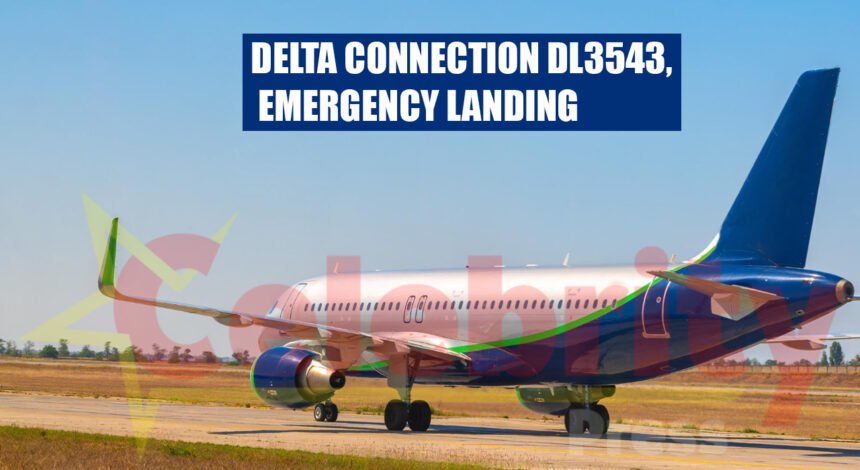
Delta Connection flight DL3543 appears to be a genuinely tracked aviation event, an Embraer 170/175-family regional jet registered N259SY that departed Minneapolis for a short flight to Chicago Midway, stopped its climb at 21,000 feet roughly ten minutes after takeoff, and turned back, with the crew declaring an emergency and squawking the internationally recognized 7700 emergency transponder code before landing safely 37 minutes after departure. What’s missing is any specific, confirmed explanation for why the emergency was declared, and no established news outlet coverage was found specifically confirming this exact flight number.
The Specific Tracked Details
According to aviation tracking coverage from AIRLIVE, a service that monitors and reports on flight transponder data, DL3543 departed Minneapolis–Saint Paul on a scheduled one-hour flight to Chicago Midway International Airport. The aircraft climbed to 21,000 feet before stopping its climb and turning around approximately ten minutes after takeoff, at which point the crew declared an emergency, indicated by the internationally recognized squawk code 7700, and the aircraft landed back at its departure airport on runway 12R, 37 minutes after departure, before taxiing to gate C12.
What Squawk 7700 Actually Means
Squawk 7700 is a standardized transponder code used by pilots worldwide to alert air traffic control to a general emergency aboard the aircraft, without specifying the exact nature of that emergency through the code itself. Pilots and airlines commonly use this code as a precautionary measure for a wide range of situations, from serious mechanical or medical emergencies to more moderate technical issues where an added margin of air traffic control priority handling is simply a sensible precaution, meaning the code’s use alone doesn’t indicate the severity or specific cause of whatever prompted it.
Why the Cause Remains Unconfirmed
The aviation tracking report itself explicitly does not identify a specific cause for the emergency declaration, providing no citation to air traffic control audio, an official Delta Connection statement, or any other primary source beyond the aircraft’s own tracked transponder and radar data. This is a meaningfully more limited sourcing basis than a fully reported incident would typically have, even though the core facts, the flight’s existence, its route, and its actual flight path, are independently corroborated through the tracking data itself.
Distinguishing This From Other Real Delta Incidents
Multiple separate, independently reported Delta-related emergency landings occurred around the same general period covered in this research, including a Delta flight from Atlanta that made an emergency landing after a battery fire, and another Delta flight diverted between Minneapolis and Chicago Midway covered by established regional news outlets. It’s important not to conflate these separate, independently reported incidents with the specific DL3543 tracking report; each represents a distinct event, and only some carry the fuller sourcing of established news coverage.
Why This Matters for Accurate Reporting
Content describing DL3543 that adds specific causal detail, claiming a particular mechanical failure, medical emergency, or other specific cause, without citing a source for that detail beyond the base tracking report, is likely embellishing beyond what the original, more limited tracking-based reporting actually supports, a distinction worth checking carefully in any specific article you encounter about this flight.
Comparing This Case’s Sourcing to a Fully Reported Incident
| Factor | Fully reported incident (established news coverage) | DL3543 tracking-based report |
|---|---|---|
| Flight existence and route | Confirmed | Confirmed via radar/transponder tracking |
| Specific cause of emergency | Typically confirmed via official statement | Not identified in the source report |
| Air traffic control audio | Sometimes cited | Not cited |
| Official airline statement | Often included | Not found |
Why Flight-Tracking-Only Reporting Still Has Value
Aviation tracking services performing this kind of squawk-code and radar-based reporting provide a genuinely useful, independently verifiable layer of aviation safety transparency, since transponder data is broadcast directly by the aircraft and isn’t dependent on any airline’s willingness to disclose an incident; the limitation is specifically about the cause, not about whether the underlying event of an emergency declaration and safe landing actually occurred.
What Passengers on This Flight Likely Experienced
A regional jet that stops its climb at 21,000 feet, declares an emergency, and returns to its departure airport within roughly 40 minutes represents a genuinely disruptive and likely frightening experience for the passengers aboard, regardless of the ultimately safe outcome, and Delta Connection passengers affected by this kind of event typically receive rebooking assistance consistent with the airline’s standard disruption handling procedures.
Why Regional Jet Emergencies Often Receive Less News Coverage
Regional jet flights, typically shorter routes with smaller passenger counts operated under a major airline’s connection brand like Delta Connection, sometimes receive comparatively less dedicated news coverage than mainline long-haul incidents unless there’s a notable injury, fatality, or unusually dramatic circumstance, which may help explain why this specific flight appears more prominently in specialized aviation tracking coverage than in general news search results.
What a Concerned Reader Should Do
If you were a passenger on Delta Connection flight DL3543 or know someone who was, contacting Delta directly through its official customer service channels is the most reliable way to get a specific, confirmed explanation of what caused the emergency declaration, since the publicly available tracking-based reporting doesn’t include this detail.
Checking Any Aviation Tracking Report Yourself
For any aviation incident reported primarily through flight-tracking or radar-based coverage rather than full news reporting, checking whether the report cites actual transponder or ADS-B data, whether it explicitly acknowledges what it doesn’t know, such as the cause, and being skeptical of any secondary article that adds confident-sounding causal detail beyond what the original tracking report actually supports are all reasonable verification habits.
The Broader Value of Squawk-Code Journalism
Aviation tracking outlets that report based on squawk codes and radar data serve a genuinely useful public function by documenting emergency declarations that might otherwise go entirely unreported, even though this reporting model inherently comes with the specific limitation of not knowing or reporting the underlying cause unless a separate, additional source, an official statement or established news follow-up, becomes available later.
Why This Case Sits Between the Other Two Aviation Cases in This Batch
DL3543 occupies a middle position between the two other aviation cases covered in this same batch: unlike the EasyJet U2238 Newcastle claim, which had no independent tracking or reporting basis at all, DL3543 does have genuine, verifiable radar-tracking data behind it; unlike the Air France A350 Chicago case, which had both tracking data and at least a limited official airline statement, DL3543’s specific cause has no official confirmation currently available.
Why the Aircraft Type Is Worth Noting
The Embraer 170/175 family is one of the most widely used regional jet types in North America, flown by numerous Delta Connection, American Eagle, and United Express partner carriers, and has an established, generally strong safety record; a single emergency declaration on one aircraft of this type doesn’t indicate any broader fleet-wide concern, consistent with how isolated emergency declarations are handled and resolved across the regional aviation industry generally.
What Independent Verification Would Look Like Going Forward
If Delta or the relevant regional carrier operating this flight under the Delta Connection brand were to release a specific statement about DL3543’s cause, or if the National Transportation Safety Board were to open any formal review given the emergency declaration, that additional sourcing would meaningfully strengthen what’s currently known about this event beyond the base tracking data, and readers specifically interested in this flight should watch for that kind of follow-up confirmation.
A Reasonable Overall Assessment
Based on available research, Delta Connection flight DL3543 represents a genuinely tracked aviation event, a regional jet that declared an emergency shortly after departing Minneapolis and returned safely, but the specific cause of the emergency remains unconfirmed by any official statement or established news source, and readers should treat any more specific causal claims found elsewhere with appropriate skepticism unless they cite additional sourcing beyond the base tracking report.
Why Minneapolis-to-Chicago Is a High-Frequency Route
The Minneapolis-to-Chicago Midway corridor is one of the busier short-haul regional routes in the Delta Connection network, operated multiple times daily, meaning a single emergency declaration on this specific route represents a tiny fraction of overall flights and shouldn’t be read as reflecting any particular concern about this corridor specifically, a useful piece of context when interpreting any single incident in isolation from the broader volume of safe, uneventful flights operating the same route.
What ATC Communications Recordings Could Add
Publicly available air traffic control audio archives, maintained independently by sites like LiveATC.net, sometimes capture the actual radio communications between a flight crew and controllers during an emergency declaration, and locating this specific recording for DL3543, if it exists in an accessible archive, could meaningfully supplement the transponder-based tracking data this guide has relied on, potentially clarifying the crew’s own stated reason for the emergency in their own words at the time it occurred.
Why Passengers Rarely Learn the Full Story Immediately
During an in-flight emergency, cabin crew typically provide passengers with only the minimum information needed to manage the immediate situation calmly and safely, meaning passengers aboard DL3543 likely didn’t receive a detailed technical explanation in real time, a standard and appropriate practice that nonetheless helps explain why full clarity about a flight’s specific cause often only emerges later, if at all, through follow-up reporting rather than during the event itself.
A Final Word on Reading Radar-Based Reports Carefully
The specific, technical precision of a radar-based report, an exact altitude, a squawk code, a runway number, can create an impression of thoroughness that exceeds what the report actually confirms about causation, a distinction worth remembering whenever a highly specific-sounding aviation report turns out, on closer reading, to explicitly acknowledge it doesn’t know why an emergency was declared in the first place.
A Closing Thought on Trusting Partial Information
Accepting that a report is only partially confirmed, rather than either fully trusting or fully dismissing it, is often the most accurate stance available for a fast-moving aviation story, and DL3543’s case is a clear, practical example of exactly that middle ground.
Conclusion
Delta Connection flight DL3543, an Embraer regional jet registered N259SY, genuinely appears to have declared an emergency and returned safely to Minneapolis shortly after departing for Chicago Midway, based on independently verifiable radar and transponder tracking data. However, the specific cause of the emergency declaration remains unconfirmed, with no official Delta Connection statement or established news source identifying it during this research, and any content claiming a specific cause should be checked for its actual sourcing.
FAQ
1. Did Delta Connection flight DL3543 really declare an emergency?
Yes, this appears to be a genuinely tracked event, confirmed through radar and transponder data showing the aircraft’s altitude, squawk code, and flight path.
2. What caused the emergency on DL3543?
The specific cause was not identified in the available tracking-based reporting, and no official Delta Connection statement confirming a cause was found during this research.
3. What does squawking 7700 mean?
It’s a standardized transponder code pilots use to alert air traffic control to a general emergency, without specifying the exact nature of that emergency.
4. Did the flight land safely?
Yes, according to the tracking data, the aircraft returned to Minneapolis and landed safely on runway 12R, 37 minutes after departure.
5. Was anyone injured on this flight?
No injury information was found in the available tracking-based reporting; this detail wasn’t addressed in the sourcing found during this research.
6. Is this the same incident as the Delta flight that had a battery fire?
No, that appears to be a separate, independently reported incident involving a different flight from Atlanta; readers should be careful not to conflate distinct Delta-related events covered around the same general period.
7. Why isn’t this incident covered by major news outlets?
Regional jet incidents without notable injuries sometimes receive less dedicated news coverage than mainline long-haul incidents, which may explain why this event appears mainly in specialized aviation tracking coverage.