

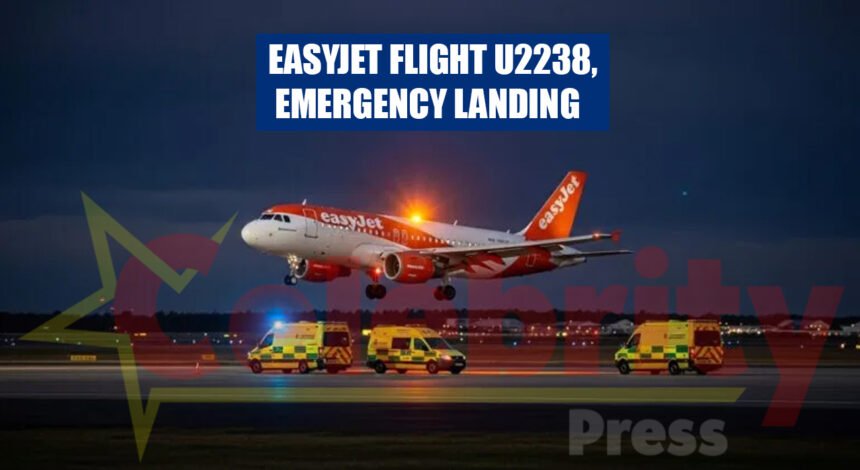
A specific, detailed narrative describing an “EasyJet Flight U2238 Emergency Landing Newcastle” during a Copenhagen to Manchester journey circulates across more than a dozen content sites, several including dramatic specifics like a passenger being “rushed to hospital.” However, no independent, established aviation safety source, no major news outlet, and no aviation incident tracking service was found confirming this specific flight number or incident during this research, a significant gap that matters more here than in most other cases in this series given the subject involves aviation safety.
What the Claim Says
The circulating content describes an EasyJet flight, numbered U2238, traveling from Copenhagen to Manchester, that diverted and made an emergency landing at Newcastle Airport, with some versions adding specific details about a passenger medical situation and hospital transport. The narrative is presented with the same confident, detailed “full timeline” and “full incident breakdown” framing used across other aviation content in this cluster.
Why This Specific Claim Couldn’t Be Verified
A search of established sources that reliably cover UK aviation incidents, including major news outlets and dedicated aviation incident tracking services like the Aviation Herald, which specializes in documenting exactly this kind of event using flight tracking data and official sources, did not surface independent confirmation of a flight numbered U2238 making an emergency landing at Newcastle under the specific circumstances described. This is a meaningfully different research outcome than was found for the other two aviation cases in this same batch, both of which had at least some independent sourcing.
The One Loosely Related Genuine Reference Found
A Newcastle Chronicle social media post referencing “an easyjet flight had to make an emergency landing” does exist, but it does not specify the flight number U2238 or confirm the specific Copenhagen-to-Manchester routing and hospital-transport details found in the more elaborate content cluster, meaning it cannot be treated as independent confirmation of this specific, detailed narrative rather than a different, more generic, or entirely separate incident.
The Content Cluster Itself
At least ten differently branded content sites, including headlinemagazine.co.uk, thoughtmagazine.co.uk, famepedias.com, eyesonhunt.com, techdailyjournal.co.uk, troozer.blog, wapbald.com, wordlehintjournal.com, travelhubdubai.com, and usmagazine.co.uk, all published detailed articles about this specific claimed incident, several using nearly identical framing like “Full Timeline, Facts & Passenger Rights” and “Full Story Explained.” One of these domains, bestcricketnames.com, has no apparent connection to aviation, travel, or news content at all, a domain mismatch pattern documented repeatedly throughout this series for fabricated or unverified claims.
Why This Pattern Resembles Other Invented Specifics in This Series
The combination of a highly specific, dramatic-sounding flight number and route, confident “full breakdown” framing, and a complete absence of independent confirmation from any established aviation or news source closely resembles the pattern already documented for terms like Jipinfeiche and the fabricated business buzzwords throughout this series, applied here to a specific claimed aviation safety event rather than a product or company name.
Why This Matters More Than a Typical Fabricated Buzzword
An invented business buzzword or entertainment term causes at most confusion or wasted time for a curious reader. A fabricated or unverified aviation incident claim carries a different and more serious kind of risk: it can mislead readers about actual aviation safety events, potentially causing needless worry for people who flew on a genuine EasyJet flight around the same period, or diluting public attention and search visibility around real, independently verified aviation safety information with unconfirmed content.
How Genuine Aviation Incidents Are Normally Documented
Real aviation incidents involving an emergency declaration or diversion are typically documented through a specific, traceable combination of sources: flight tracking data from services like FlightRadar24 showing the actual flight path and squawk code, air traffic control audio recordings, an airline’s own official statement, and coverage from established news outlets or the specialized aviation incident tracking site Aviation Herald, which cross-references exactly this kind of data as standard practice for its reporting.
Comparing This Case to Genuinely Documented Aviation Incidents
| Factor | Genuinely documented incident (see this batch’s other cases) | EasyJet U2238 Newcastle claim |
|---|---|---|
| Flight tracking data cited | Yes, typically FlightRadar24 or similar | Not found |
| Established news or aviation outlet coverage | Yes, at least partial | Not found |
| Official airline statement | Sometimes limited, but often present | Not found |
| Independent confirmation of the specific flight number | Present | Not found |
What a Reader Should Take From This
If you encountered this specific claim and were concerned about it, whether because you were booked on an EasyJet flight around the relevant period or simply came across the story, the most accurate and responsible conclusion based on available research is that this specific incident, as described with this specific flight number and these specific details, cannot currently be independently verified through any established aviation safety or news source.
Why This Doesn’t Mean No EasyJet Incident Ever Occurred
It’s worth being careful and precise here: this research doesn’t prove that no EasyJet flight has ever diverted to or made an emergency landing at Newcastle Airport, genuine aviation incidents involving diversions and precautionary landings happen periodically across the industry as a normal part of how aviation safety systems function. What this research specifically found is that this particular claimed flight number, route, and set of details couldn’t be independently confirmed.
How to Verify Any Specific Aviation Incident Claim Yourself
For any specific aviation incident claim, checking the Aviation Herald’s own database, searching the airline’s official social media and press statements, and checking established national or regional news outlets directly, rather than relying on general content or “explainer” sites, is the most reliable way to confirm whether a specific claimed incident actually occurred as described.
Why Aviation Incidents Are a Particularly Attractive Content Target
Aviation incident stories reliably generate strong search interest and emotional engagement, given how viscerally most people respond to any suggestion of an in-flight emergency, making this a predictable target for content generated primarily to capture search traffic around a plausible-sounding but potentially fabricated or exaggerated specific incident, especially when a real airline name and a real destination city are combined with an invented or unverified specific flight number.
What Genuine Concern Would Look Like
If you have a specific, personal reason to be concerned about a particular EasyJet flight, whether you or someone you know was booked on it, the appropriate step is contacting EasyJet directly through its official customer service channels rather than relying on any third-party content site’s account, verified or not, since only the airline itself can confirm what actually happened on a specific flight you have a genuine, direct connection to.
Why Flight Number Formatting Is Worth Checking
EasyJet’s actual flight numbers follow the “U2” prefix used in this claim, since U2 is EasyJet’s genuine IATA airline code, meaning the flight number format itself is plausible and doesn’t immediately reveal the claim as fabricated; this is precisely why format plausibility alone is insufficient for verification, and why checking for independent confirmation of the specific numbered flight remains the necessary additional step.
What This Case Adds to the Series
This EasyJet case extends a pattern already seen with invented business buzzwords and inconsistent lifestyle terms into a new and more consequential category: a specific, named real-world safety event attached to a real airline and a real city, demonstrating that the same search-traffic-driven content production techniques documented throughout this series can and do extend into aviation safety topics, where the stakes of getting it wrong are meaningfully higher.
A Reasonable Overall Assessment
Based on available research, the specific claim of an “EasyJet Flight U2238 Emergency Landing Newcastle” during a Copenhagen to Manchester journey cannot currently be independently verified through any established aviation safety database, news outlet, or official airline statement, despite circulating across a substantial cluster of content sites presenting it with confident, detailed framing.
Why UK Aviation Incidents Are Normally Well-Documented
The United Kingdom has an unusually robust aviation safety reporting culture, with the Air Accidents Investigation Branch publishing detailed bulletins on notable incidents and mainstream UK outlets routinely covering airport diversions affecting their local area, making the complete absence of any such coverage for this specific claimed Newcastle incident considerably more conspicuous than it might be in a country with less developed aviation journalism infrastructure.
What a Genuine Hospital-Transport Claim Would Require
A claim as specific and serious as a passenger being rushed to hospital following an in-flight medical emergency would typically be independently confirmable through local ambulance service statements, an airport authority’s own incident log, or at minimum a specific, named local news report, none of which were found supporting this particular detail despite its prominent appearance in at least one widely circulated version of this story.
Why Newcastle Airport Specifically Was a Plausible Choice
Newcastle International Airport is a genuine, active diversion point for flights over northern England and the North Sea, meaning choosing it as the setting for this claim was a plausible, geographically sensible detail rather than an obviously implausible one, which likely contributed to the story’s apparent credibility despite the underlying lack of independent confirmation for this specific flight.
Why Newcastle Airport Specifically Was a Plausible Choice
Newcastle International Airport is a genuine, active diversion point for flights over northern England and the North Sea, meaning choosing it as the setting for this claim was a plausible, geographically sensible detail rather than an obviously implausible one, which likely contributed to the story’s apparent surface credibility despite the underlying lack of independent confirmation for this specific flight.
A Final Word on Verifying Before Sharing a Safety Story
Before sharing or repeating any specific aviation incident story, a quick check of the Aviation Herald’s database or a search of established news outlets by the specific flight number takes only a minute and can prevent inadvertently spreading an unverified or fabricated safety claim further.
Conclusion
The specific claim describing an EasyJet Flight U2238 emergency landing at Newcastle during a Copenhagen to Manchester journey could not be independently confirmed through established aviation incident tracking sources, major news outlets, or any official EasyJet statement, despite circulating across more than a dozen content sites with confident, detailed framing. This doesn’t rule out the possibility that some EasyJet-related incident occurred, but the specific flight number and details currently rest only on an unverified content cluster rather than independently confirmed reporting.
FAQ
1. Did EasyJet Flight U2238 really make an emergency landing at Newcastle?
This specific claim could not be independently verified through any established aviation safety database, news outlet, or official EasyJet statement during this research.
2. Why do so many websites report this incident if it can’t be verified?
The pattern, a specific, dramatic-sounding claim spread across many similarly structured content sites without independent sourcing, resembles other fabricated or unverified claims documented throughout this series.
3. Should I be worried if I’m booked on an EasyJet flight?
General aviation safety statistics remain very strong, and this specific unverified claim shouldn’t be treated as evidence of any particular ongoing safety concern with EasyJet specifically.
4. How can I check if a specific flight incident actually happened?
Check the Aviation Herald’s incident database, the airline’s official statements, and established news outlets directly, rather than relying on general content or explainer sites.
5. Does this mean no EasyJet flight has ever diverted to Newcastle?
No, this research only found that this specific claimed flight number and set of details couldn’t be independently verified, not that no related event of any kind has ever occurred.
6. What should I do if I have a specific concern about a flight I or someone I know was on?
Contact EasyJet directly through its official customer service channels, since only the airline can confirm details about a specific flight you have a direct connection to.
7. Is this the same kind of case as the other aviation incidents covered in this batch?
No, the Air France and Delta Connection cases covered elsewhere in this batch had at least some independent flight-tracking or reporting basis, while this EasyJet claim had none found.