
Bringing a car in from Japan, Germany or anywhere else overseas can feel like the hard part is over once it clears customs. Then comes the question that catches many new owners out: does an imported car need an MOT in the UK, and when?
The short answer is yes. Once an imported car is registered and used on UK roads, it follows the same MOT rules as any UK car. It needs its first test by the third anniversary of its registration and then every year after that. The twist is that a car which is already more than three years old when it arrives usually needs MOT evidence before the DVLA will register it, so the test comes first rather than later. If your import is already on UK plates and due a test, booking MOT testing in Fleet with a garage that understands the quirks of imported cars is a sensible place to start.
This guide covers when the first MOT is due, how Japanese and grey imports fit in, how an IVA test differs from an MOT, how to check whether a car is imported, and what tends to trip imported cars up on test day.
Do Imported Cars Need an MOT in the UK? The Direct Answer
Yes. An MOT is a UK roadworthiness check, and it applies to cars used on UK roads wherever they were built or first sold. A foreign roadworthiness certificate, however recent, does not replace it.
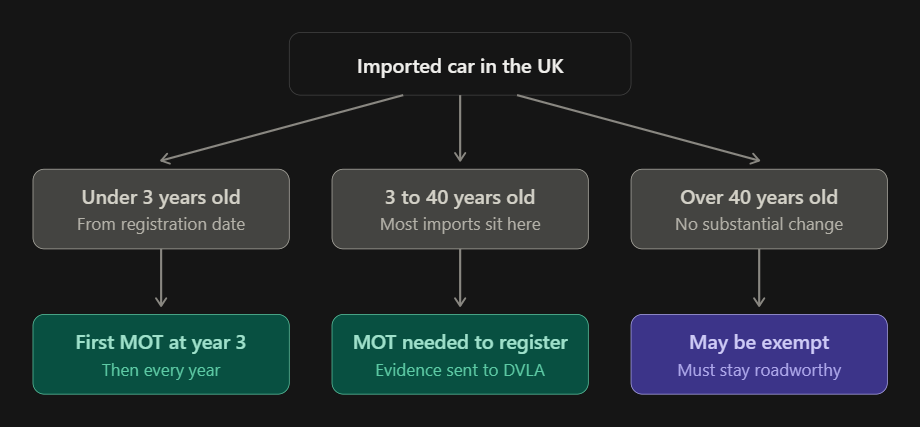
What changes for an import is not whether you need an MOT, but when the first one falls due and whether the car needs separate approval before it can be registered at all. Here is the position at a glance.
| Situation | MOT position |
| Imported car under 3 years old | No MOT yet. The first test is due by the third anniversary of registration |
| Imported car over 3 years old | MOT evidence is needed to register it with the DVLA, then a test every year |
| Imported car over 40 years old with no substantial changes in the last 30 years | May be exempt, but it must still be kept roadworthy |
| Imported car already registered and taxed in the UK | Same MOT rules as any other UK car |
Government rules on approval, registration and exemptions can change, so it is worth confirming the details on GOV.UK before you rely on them.
When Does an Imported Car Need Its First MOT?
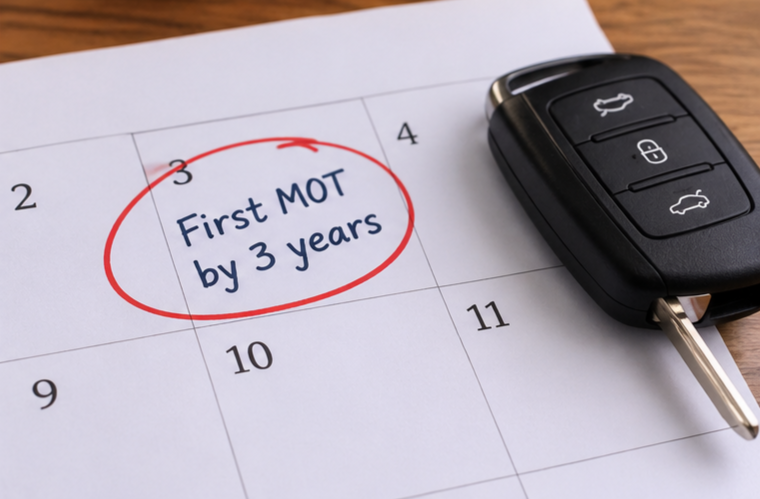
The general rule is that a car needs its first MOT on the third anniversary of its registration. For an imported car, what happens next depends on how old the car is when it arrives.
Imported cars that are under 3 years old
These cars are not due a test yet. The first MOT is due by the third anniversary of registration. For an import, the date that counts comes from the registration record, which can reflect the date the car was first registered abroad rather than the day it reached the UK. Where the registration date is not known, a common approach is to add three years to the date of manufacture. Check the dates on your V5C registration certificate and look up the MOT due date once the car is on the system, rather than counting on your own sums.
Imported cars that are over 3 years old
Here the MOT comes before registration. GOV.UK says that when you apply to register a used imported vehicle you must send evidence of a current MOT if the car is over 3 years old, and a copy of the MOT history is accepted. In Northern Ireland the threshold is over 4 years.
In practice that means the car gets its first UK MOT while it is still working its way through the import process. GOV.UK allows you to drive it to a pre booked MOT or vehicle approval test during that stage, but not for ordinary journeys. Not every test centre is set up to test a car that is not yet registered, so ring ahead and explain the situation before you turn up.
After the first MOT
From then on the car is on the normal yearly cycle. You can have the test up to a month, minus a day, before the current certificate expires and keep the same renewal date. Leave it later and the renewal date resets from the day you pass.
Imported classics and the 40 year rule
Some older imports are exempt from the MOT altogether. GOV.UK says a vehicle does not need an MOT if it was built or first registered more than 40 years ago and has had no substantial changes in the last 30 years. For an imported classic, the build date, the registration date and the work done to it over the years all matter. A car that has been restored with a replacement chassis, body or engine that changes how it works may lose the exemption.
Even when a car is exempt, it must still be kept in a roadworthy condition, and plenty of owners of older imports choose a voluntary MOT for peace of mind. Check the GOV.UK guidance on how to declare the exemption before you assume it applies.
Do Japanese Import Cars Need an MOT?
Yes. Japanese import cars, often called grey imports because they arrive outside the official manufacturer channels, need an MOT in exactly the same way as any other car. A Japanese inspection history has no standing here, and the car has to meet UK test standards on the day.
Japanese imports are a popular route into the UK car scene, and they have a few things in their favour. Japan drives on the left, so most of these cars are right hand drive with lights already designed for left hand traffic, which avoids the biggest headlight problem faced by cars from mainland Europe. Many are also well looked after and arrive with low mileage for their age.
They do come with their own list of things to check:
- Speedometer units. Japanese cars usually show kilometres per hour, so the speedometer may need converting or swapping before the car is comfortable to use in the UK.
- Rear fog lamp. Some models arrive without one, or with it fitted in the wrong place for UK rules.
- Underside corrosion. Cars from coastal or snowy areas where roads are salted can hide rust that only shows up once the car is on a ramp.
- Parts and paperwork. A car with unusual parts or no UK service history takes more care to assess, so it is worth having it looked over before the test rather than during it.
As a rough guide, a Japanese import that is under 10 years old is likely to need vehicle approval before it can be registered, while an older one often does not, but that depends on the individual car, so confirm it with the DVLA guidance first.
What Is an IVA Test, and How Is It Different From an MOT?
IVA stands for Individual Vehicle Approval. IVA for cars is an inspection of how a vehicle is built or adapted and, according to GOV.UK, it is separate from the annual MOT. It is carried out by the DVSA, and the approval you receive is the proof the DVLA needs before it registers the car.
An IVA test is not a roadworthiness check you repeat every year. It is a one off approval that shows the car meets safety and environmental standards. The government says you must send proof of vehicle approval when registering a used import that is under 10 years old, unless an exemption applies. Left hand drive cars from the EU may need a GB conversion IVA certificate on top of their paperwork.
An IVA inspection looks closely at the things that make a foreign market car suitable for British roads. GOV.UK says it covers points such as a speedometer that shows mph, headlamp aim for driving on the left, and a correctly fitted rear fog lamp.
| MOT | IVA test | |
| What it is | An annual roadworthiness and emissions check | A one off approval of how the car is built or adapted |
| Purpose | Shows the car is safe to keep using | Shows the car meets standards so it can be registered |
| How often | Every year once the car is three years old | Usually once, before registration |
| Needed for an import | Yes, once it is old enough, or before registration if over 3 years old | Often, depending on the car’s age and origin |
| Does it replace the other | No | No |
| Certificate | MOT certificate | IVA certificate sent to the DVLA |
An IVA certificate does not replace an MOT, and an MOT does not replace an IVA test. An imported car can need both, and the order of events matters.
How to Check If a Car Is Imported
Is my car an import? It’s a common question if you’ve just bought a used car, or you’re about to. Here’s how to check if a car is imported. A few clues usually tell you.
| What to check | What it can tell you |
| Dates on the V5C | A first registration date that is later than the year the car was built can point to an import |
| Build plate and VIN sticker | Text in another language or a foreign market marking |
| Dashboard and displays | Speed in kilometres per hour, foreign language menus or a foreign sat nav |
| MOT history on GOV.UK | A first MOT that starts later than the car’s age suggests |
| DVLA vehicle enquiry service | Compare the year of manufacture with the first registration date |
| Service history | Little or no UK history, or paperwork in another language |
| Driving side and lights | Left hand drive, or lamps with a different beam pattern |
A single clue is not proof. Two or three together make a convincing case. If you are buying and want certainty, a car import check through a history report, plus a conversation with the seller, will clear it up. Knowing a car is imported matters because it affects which MOT date applies, whether it was approved properly, and what to look at in the test.
Can You Drive an Imported Car Without an MOT?
If the car needs an MOT and does not have one, no. A car that has not been registered and taxed cannot be used on public roads for normal journeys either, and UK residents can only use a foreign-registered car for a limited time before it must be registered here.
There are limited exceptions. GOV.UK says that during the import process you can drive to a pre booked MOT or vehicle approval test. If your car fails its MOT you can usually drive it away to get it repaired, as long as the old certificate is still valid and the car has no dangerous defect, and you should always drive straight to a pre booked repair.
Outside those exceptions, the risks are real. You can be fined and penalised, and your insurance can be affected if the car is found to be without a valid MOT. You also cannot renew the car’s tax if the MOT has expired. Here is how the route from arrival to the road usually fits together.
- Get vehicle approval (such as an IVA) if the car needs it.
- Get an MOT if the car is over 3 years old.
- Register the car with the DVLA and fit UK number plates.
- Tax and insure the car before ordinary use on the road.

Common MOT Problems on Imported Cars
Imported cars fail the MOT for the same reasons as any other car, such as worn tyres, brakes and bulbs. But a few problems turn up more often because the car was built and set up for another market.
| Area | What can go wrong | What to do |
| Headlight beam pattern | Lamps built for driving on the right throw the dipped beam the wrong way, which can dazzle oncoming drivers | Fit UK-pattern headlamps or a suitable beam converter, and ask your garage what will be accepted on the test |
| Speedometer in mph | A kilometres per hour only display is awkward to use, and GOV.UK says the IVA approval check needs a speedometer that shows mph | Fit a converted cluster or a dual display |
| Rear fog lamp | Cars first used on or after 1 April 1980 need a rear fog lamp on the centre or offside. Some imports have none or have it on the wrong side | Add or move the lamp to the correct position |
| Number plates | Foreign size plates, or plates that are hard to read, can cause a problem | Fit correctly sized, legible UK plates |
| Corrosion | Older imports and cars from salted roads can hide rust in structural areas | Get an underside inspection before the test |
| Warning lights and emissions | Cars with unusual or removed emissions parts may not run cleanly | Have a diagnostic check and fix any faults |
Most of these are quick to sort out once you know about them. The trouble is discovering them on test day, after you have already booked a slot and perhaps burned a day off work.
Getting an Imported Car Ready for Its MOT
A little preparation saves a lot of hassle:
- Check the paperwork. Make sure the registration details and approval evidence are in order before the test.
- Look at the lights. Check every bulb, the dipped beam pattern and the rear fog lamp.
- Confirm the speedometer. Make sure it works and shows speed in mph.
- Inspect tyres and brakes. Look at tread depth, tyre condition and brake wear.
- Check the underside. Have the car on a ramp and look for corrosion in structural areas.
- Clear any warning lights. A lit warning light needs investigating before the test, not after.
Drivers around Fleet and Church Crookham often find it easiest to have the car looked over by a garage that handles imports regularly, so any surprises are found and fixed before the official test.
What Happens If an Imported Car Fails Its MOT?
A fail is not unusual for an imported car, especially on the first test. The tester grades each problem as dangerous, major, minor or advisory. A dangerous or major defect means a fail. Minor and advisory items are recorded but the car can still pass.
If the car has a dangerous defect, it should not be driven away until it has been repaired. For other fails, you can usually drive to a pre booked repair, provided any old certificate is still valid and nothing is unsafe. Cars that are still in the import process need the same care, because you are only allowed to drive to a pre booked test or repair stage.
Once the repairs are done, the car needs a retest. If you leave it at the test centre for the work, or bring it back within 10 working days, you may only need a partial retest of the failed items. Ask the garage how this works at the time of booking.
Lighting, speedometer and fog lamp problems are among the quickest imported car fails to fix, which is another good reason to have them checked before the test.
Looking for a garage near Hook, Yateley or Hartley Wintney that knows the quirks of imported cars? TJ Services Fleet is based in Church Crookham and looks after drivers across Fleet and the surrounding villages.
Keeping an Imported Car on the Road After the MOT
Keeping an Imported Car on the Road After the MOT
- Parts: models never sold in the UK can take longer to source parts for, so ask about availability early.
- Specification: tell your garage the car is an import, so fluids, filters and parts match the manufacturer’s spec.
- Service history: start a UK service record. It helps you, and the next owner.
- Due dates: note your MOT due date as soon as the car is on the system, and book a few weeks early.
Treat the first year as a settling-in period, and small issues are far easier to deal with before they affect the next MOT.
Conclusion
Yes. Imported cars follow the same MOT rules as any UK car, but the timing can be different. A car under three years old needs its first MOT by the third anniversary of registration, while an older import needs MOT evidence before the DVLA will register it.
Remember that an IVA test and an MOT are separate, and an import can need both. Before the test, check the headlights, speedometer, rear fog lamp and underside for rust. For an MOT in Fleet from a team that knows imported cars, call TJ Services Fleet in Church Crookham on 01252 622200.
Frequently Asked Questions
Does an imported car need an IVA test?
It depends on the car. GOV.UK says you must send proof of vehicle approval when registering a used imported vehicle that is under 10 years old, unless it is exempt. Older cars often do not need approval, and left hand drive cars from the EU may need a GB conversion IVA certificate. Check the current guidance for your specific car.
Do grey imports have different MOT rules?
No. A grey import, such as a Japanese domestic market car, has to meet the same MOT standard as any UK car. The difference is in the registration process, since approval may be needed first, and in the faults imports are more likely to have, such as lighting and speedometer units.
What documents do I need for an imported car’s MOT?
At the test itself the tester mainly needs the car and its registration details. It helps to bring your V5C if you have one. For registering the car with the DVLA you will need more, including the foreign registration document, proof of the collection date, evidence of approval, UK insurance and MOT evidence if the car is over 3 years old. GOV.UK has the full list.
When does an imported car need its first MOT?
By the third anniversary of its registration. If the car is already more than 3 years old when you import it, you need MOT evidence before the DVLA will register it.
Can I drive an imported car without an MOT?
Not if it needs one. During the import process you can drive to a pre booked MOT or approval test, but not for ordinary journeys, and you cannot renew the tax on a car with no valid MOT.
Are imported classic cars exempt from the MOT?
They can be, if the car was built or first registered more than 40 years ago and has had no substantial changes in the last 30 years. The car must still be kept roadworthy.