


Engine misfire explained: what causes it, the symptoms to watch for and whether it is safe to drive. Learn when to stop and how a mechanic finds the fault.
You are sitting at the lights on a wet Monday morning and the car starts to shake like a washing machine on a fast spin. The revs dip, the bonnet trembles, and when the lights change the car coughs, hesitates and then lurches forward. If that sounds familiar, you have almost certainly met an engine misfire.
An engine misfire happens when one or more of the cylinders fails to burn its mixture of fuel and air properly. The engine keeps running, but it runs unevenly, which is why a car misfire is so easy to feel and so easy to put off. Whether it is safe to drive depends on how bad it is. A mild misfire with a steady engine light usually allows a short, careful trip to a garage, but a flashing light, heavy shaking or a sudden loss of power means you should stop as soon as it is safe to do so.
This guide explains what a misfire is, how to recognise the symptoms, what causes a misfiring engine, when it is safe to keep driving, how a mechanic tracks the fault down and how to stop it happening again. Whether you cover your miles around Aldershot every day or only make the odd trip, it helps to know what your car is trying to tell you.
What Is an Engine Misfire? The Meaning in Plain English
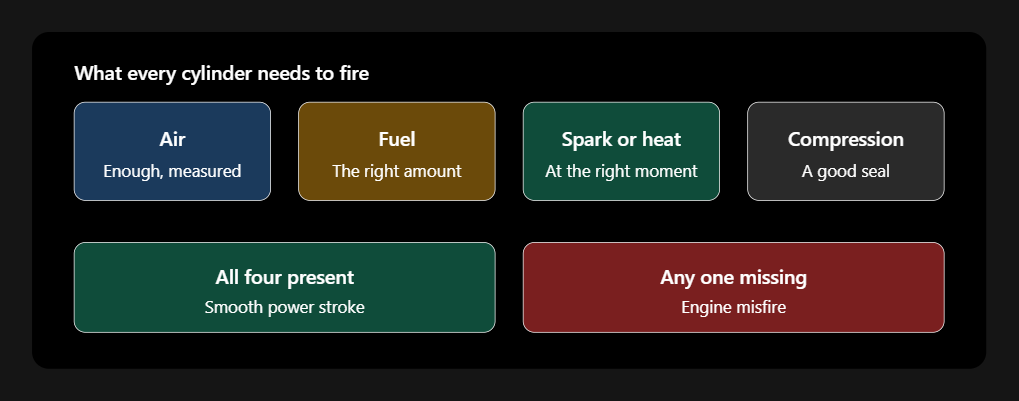
So what is a misfire in a car? Put simply, it’s a combustion cycle that fails. Each cylinder in your engine repeats the same four steps hundreds of times a minute. It draws in air, squeezes it, ignites it with fuel, and then pushes out the burnt gases. When one of those steps goes wrong, that cylinder produces little or no power for that cycle, and that is exactly what people mean when they ask what an engine misfire is.
A healthy cylinder needs four things at the right moment: the correct amount of fuel, enough air, a strong spark (or, in a diesel, the heat of compression) and good compression inside the cylinder. Weaken or remove any one of them and the result is the same. The engine misfire means really just a cylinder that missed its turn.
Drivers describe it in different ways. Some say the engine is “missing” or “running on three”, and mechanics often call it a motor misfire. It can be a single stumble now and then, a constant fault on one cylinder, or several cylinders failing together. A one-off stumble is rarely a worry, but a repeating pattern tells you that something is wearing out, leaking or failing.
The car misfiring meaning is the same every time. It can be a single stumble now and then, a constant fault on one cylinder or several cylinders failing together. A one off stumble is rarely a worry, but a repeating pattern tells you that something is wearing out, leaking or failing.
Engine Misfire Symptoms: How to Tell Your Car Is Misfiring
The signs of a misfire range from barely noticeable to impossible to ignore. Early on you might only notice a slightly rough tickover when you pull up outside the shops in Ash. Later the car may judder, smell of fuel or fill the cabin with a dull throbbing that you can feel through the steering wheel and the seat. These are the most common engine misfire symptoms:
- A shaking or juddering feeling, especially at idle or at a steady speed
- A rough, uneven idle with the rev counter bouncing up and down
- Hesitation, stumbling or jerking when you press the accelerator
- Noticeably less power, particularly on hills or when overtaking
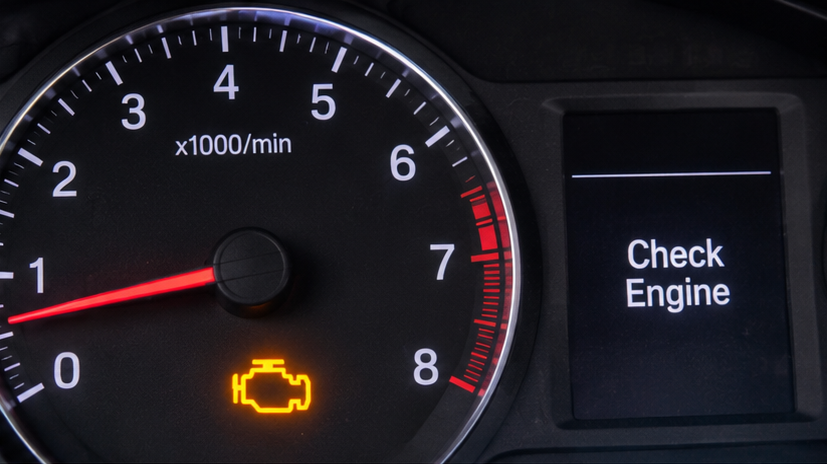
- A steady or flashing engine management light on the dashboard
- Popping, spluttering or a ragged beat from the exhaust
- A smell of raw petrol or a sharp sulphur smell from the exhaust
- Worse fuel economy than usual
- Difficulty starting, or the engine stalling at junctions
Not every misfire produces every symptom, and the feel varies with the engine. A four cylinder engine that loses one cylinder loses a quarter of its power strokes, which you feel as a heavy shudder. A larger engine can smooth the problem over for longer, which means the fault may be further along by the time you notice it.
Engine Misfire at Idle
An engine misfire at idle is often the first sign drivers notice, because the engine is turning slowly and every missed cycle is obvious. You may feel the whole car tremble at a red light, or watch the revs hunt up and down while you sit in the queue through North Camp. At idle the engine is very sensitive to small air leaks, worn spark plugs and sticky injectors, so these are common suspects. A misfire that settles down once you are moving but returns every time you stop is a classic pattern worth mentioning to your mechanic.
Engine Misfire When Accelerating
An engine misfire when accelerating usually points to a component that copes at light load but struggles when the engine works harder. A weakening ignition coil, a tired spark plug or a fuel pump that cannot keep up with demand will all show themselves when you press the pedal on a slip road or a hill. The car may stumble, surge, or feel as though it has hit a wall at a certain rev range. Because this happens under load, it is also the pattern that tends to be most worrying for the catalytic converter.
Misfire on a Cold Start
Some misfires appear only for the first minute or two after a cold start and then vanish as the engine warms up. In a petrol car this can point to worn plugs, a weak coil or a sensor that misreads the temperature of a cold engine. In a diesel it often points to faulty glow plugs or a worn injector. It is tempting to ignore a fault that disappears, but it is usually a sign that the problem is on its way to becoming permanent.
What Causes Engine Misfire? The Main Culprits
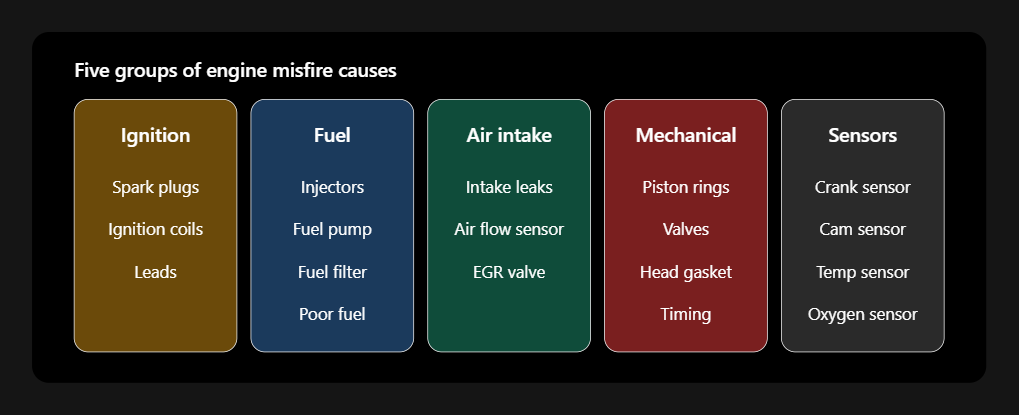
When people ask what causes engine misfire, the honest answer is that there is a long list, but nearly all of it falls into five groups. Understanding what causes misfiring in an engine makes it far easier to follow what your mechanic is explaining, and far less likely that you will pay to replace parts that were never at fault.
Ignition System Faults
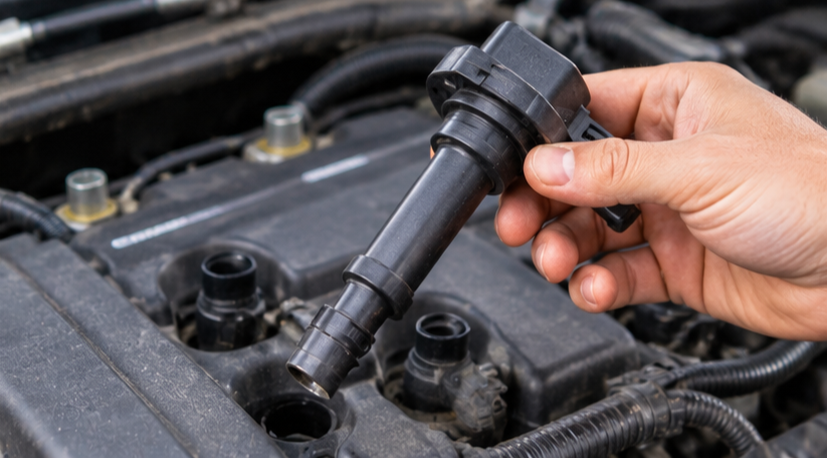
The ignition system is the most common source of an engine misfire in petrol cars, and it is one of the easiest to understand. Each cylinder needs a spark at exactly the right moment. That spark is created by a spark plug, which is fed by an ignition coil. Over many thousands of miles the plug electrode wears, the gap widens and the spark weakens. A tired coil can work perfectly when the engine is cold and then break down as it heats up, which is why some misfires seem to come and go. Older cars may use high tension leads that crack or leak.
Plug life varies hugely. Some modern plugs are designed to last well beyond 60,000 miles, while basic types need changing far sooner, so your handbook is the place to check. As a rule, if a misfire gets worse under load, such as climbing a hill or overtaking, the ignition system sits high on the suspect list.
Fuel System Faults
A blocked or sticky injector delivers the wrong amount of fuel, so the mixture is too weak or too rich to burn cleanly. A weak fuel pump or a clogged fuel filter starves the engine when demand is highest, which shows up as stumbling under hard acceleration. Poor quality or contaminated fuel can also cause misfiring shortly after a fill up, particularly if water has found its way into the tank.
Fuel faults often come with extra clues. You might notice hard starting, a smell of petrol, black smoke from the exhaust or fuel economy that quietly gets worse over a few weeks.
Air Intake and Vacuum Leaks
Engines are carefully balanced to burn the right ratio of air to fuel. A split intake hose, a loose connector or a perished gasket lets in extra air that the engine computer has not measured, so the mixture becomes too weak to ignite reliably. A dirty or failing air flow sensor can cause the same trouble by reporting the wrong amount of air, and a sticking exhaust gas recirculation valve can dilute the mixture at the wrong moment. These faults often cause a high or unstable idle, sometimes with a faint hissing sound under the bonnet.
Mechanical and Compression Problems
Worn piston rings, burnt or bent valves, a failing head gasket or a timing belt or chain that has stretched or jumped a tooth can all rob a cylinder of compression. These are the faults nobody wants, because compression is the foundation of combustion. The clue is usually a persistent misfire on one cylinder that does not improve after new plugs and coils. You may also see coolant loss, oil that looks milky, or blue or white smoke from the exhaust. A compression test or a leak down test confirms what is going on.
Sensor and Engine Management Faults
Your engine computer relies on sensors to decide when to fire the spark and when to inject the fuel. The crankshaft position sensor tells it exactly where the engine is in its cycle, and if that signal drops out the computer can lose its timing and cause sudden misfires or even stalling. A faulty coolant temperature sensor can make the engine run too rich or too lean, and oxygen sensors that drift out of range upset the mixture further. These faults can mimic mechanical problems, which is why reading the data matters before parts are replaced.
Why Diesel Engines Misfire Too
Diesel engines have no spark plugs, because the fuel ignites under the heat of compression. A diesel misfire therefore usually traces back to a worn, leaking or blocked injector, faulty glow plugs on a cold start, low compression or a sticking exhaust gas recirculation valve. A boost leak from the turbocharger pipework can also upset the mixture. The symptoms feel familiar: rough running, loss of power, and often a puff of smoke from the exhaust.
Here is a quick guide to how the most common causes tend to show themselves.
| Likely Cause | Typical Clue | How Urgent |
| Worn spark plugs | Rough idle, hesitation under load | Moderate, book soon |
| Failing ignition coil | Shaking that comes and goes, worse when warm | Moderate to high |
| Dirty or leaking injector | Rough running, poor economy, fuel smell | Moderate to high |
| Vacuum or intake leak | High or unstable idle, hissing noise | Moderate |
| Sensor fault | Stalling, hard starting, erratic idle | Moderate |
| Low compression | Constant misfire on one cylinder, smoke, coolant loss | High |
Is It Safe to Drive With an Engine Misfire?
The honest answer is that it can be, for a very short distance, but you should never treat it as safe to carry on as normal. A misfire is a warning that unburnt fuel is entering the exhaust and that the engine is not delivering smooth power. The risk comes in two parts: damage to the car, and danger on the road.
When a Short, Careful Drive May Be Acceptable
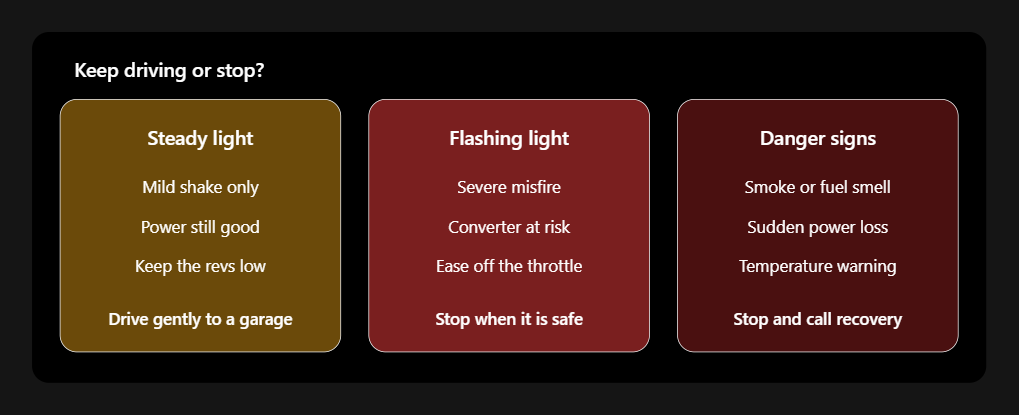
If the engine light is steady rather than flashing, the shaking is mild, the car still pulls reasonably well and there is no smoke, smell or warning about temperature or oil pressure, a short and gentle drive to a garage is usually reasonable.
Keep the revs low, avoid heavy acceleration, do not tow or carry a heavy load and head straight to be checked rather than finishing your errands first. This is not the moment for a long motorway trip. If you’re in Aldershot, a local independent garage such as Ash Road Service Centre can check the car before a small misfire turns into a bigger repair.
When You Should Stop Straight Away
Stop as soon as it is safe to do so if any of these happen:
- The engine management light starts flashing
- The car shakes violently or loses power suddenly
- You can smell fuel or see smoke from the exhaust or the bonnet
- A temperature warning or an oil pressure warning appears alongside the misfire
- The exhaust begins to glow, rattle or smell of burning
Switch off the engine, move to a safe place and arrange recovery. It is far better to wait for a lift than to turn a repairable fault into a serious one.
How a Mechanic Diagnoses an Engine Misfire
Because so many different faults cause the same symptom, good diagnosis is about narrowing down the possibilities rather than guessing. A typical process looks like this:
- Listen to your description of when the misfire happens, such as at idle, under load, when cold or only in the wet
- Read the stored fault codes through the diagnostic port under the dashboard
- Check the live data and freeze frame information to see exactly what the engine was doing when the fault was logged
- Inspect the spark plugs, ignition coils, leads and connectors for wear, cracks and moisture
- Swap a suspect coil to a different cylinder to see whether the misfire follows it
- Test fuel pressure and injector operation
- Check for air leaks, often with a smoke test that shows where air is getting in
- Carry out a compression or leak down test if the cause is still unclear
The fault codes are a useful starting point. Misfire codes follow a pattern, which is why they are so helpful for narrowing down the problem.
| Fault Code | What It Means |
| P0300 | Random or multiple cylinder misfire |
| P0301 | Misfire detected on cylinder 1 |
| P0302 | Misfire detected on cylinder 2 |
| P0303 | Misfire detected on cylinder 3 |
| P0304 | Misfire detected on cylinder 4 |
| P0420 | Catalyst efficiency below threshold, sometimes the result of a long-running misfire |
Engines with more cylinders continue the pattern, so P0305 to P0308 cover cylinders five to eight. A code only tells you where the misfire is happening, not why. A cylinder two code could mean a bad plug, a bad coil, a clogged injector or low compression on that cylinder, and replacing the wrong part wastes time and money.
That is why a visit to a car mechanic in Aldershot, or wherever you are, should start with diagnosis rather than guesswork, and why a mechanic who explains what they found, and what they ruled out, is worth listening to.
Car Misfire Repair Cost: What Affects the Bill
Car misfire repair cost is the question every driver asks and the one nobody can answer honestly without a diagnosis. A misfire is a symptom, not a fault, and replacing a worn spark plug belongs to a completely different world from repairing a failed head gasket. Any figure quoted over the phone before the car has been checked is little more than a guess.
Several things shape the final bill:
- Which part has failed, since a plug, coil, injector, sensor or a deeper mechanical fault all differ enormously
- How many cylinders are affected, because a single failed coil is a smaller job than a set of tired ones
- How easy the part is to reach, as some engines hide plugs and coils under covers and manifolds
- The type and quality of parts fitted
- The time needed for diagnosis, testing and the repair itself
- Whether secondary damage has already occurred, such as to the catalytic converter
The best advice is to ask for a diagnosis first, request an explanation of what is urgent and what can wait, and ask for a clear estimate before work begins. Acting early is almost always kinder to your wallet, because the earlier the stage, the smaller the repair. Your car, your mileage and the exact fault all change the picture, so be wary of anyone promising a fixed figure before they have looked.
How to Prevent Engine Misfires
You cannot prevent every fault, but most misfires are the result of ordinary wear that regular care would have caught early. These habits make a real difference:
- Follow the service schedule in your handbook, because fresh oil, filters and a proper inspection catch small problems before they spread
- Replace spark plugs at the interval your manufacturer recommends, and do not stretch it because the car still seems fine
- Use good quality fuel and avoid running the tank right down to empty, which can stir up sediment and strain the fuel pump
- Replace the air filter on time so the engine can breathe properly
- Act on small signs of rough running straight away, instead of waiting for the engine light
- Give the engine an occasional longer run, because short stop and start trips around Aldershot do not let the engine and exhaust reach full working temperature
- Never ignore a warning light, even if the car seems to drive normally
Conclusion
An engine misfire means one or more cylinders isn’t burning its fuel properly, usually because of an ignition, fuel, air, sensor or compression fault. A steady engine light and mild shaking usually allow a short, gentle drive to a garage. A flashing light, violent shaking, smoke, a fuel smell or sudden power loss mean you should stop and call for help.
Get the fault diagnosed before parts are replaced, and act early, because a misfire left alone can damage the catalytic converter. Drivers in Aldershot can call Ash Road Service Centre on 01252 342086 or get directions to the garage at Unit A, 151 Ash Road, GU12 4DB.
Frequently Asked Questions
What is a misfire in a car?
A misfire is when one or more cylinders fails to burn its fuel and air mixture properly. The engine still runs, but it shakes, hesitates or loses power because that cylinder is not contributing as it should.
Can I drive with an engine misfire?
You may be able to manage a short, gentle trip to a garage if the engine light is steady and the symptoms are mild. If the light is flashing, the car is shaking badly or you notice smoke, a fuel smell or a loss of power, stop driving as soon as it is safe.
What does a flashing engine light mean with a misfire?
A flashing engine management light usually signals a severe misfire that could be overheating the catalytic converter. Reduce speed, avoid hard acceleration, stop safely and have the car checked before driving it any further.
Can an engine misfire fix itself?
Sometimes a misfire seems to disappear, for example when a damp coil dries out, but the underlying wear remains. A fault that comes and goes usually returns, so it is still worth having it checked.
Can bad fuel cause an engine misfire?
Yes. Contaminated or poor quality fuel, including water in the tank, can cause misfiring, rough running and hesitation. If the problem started soon after filling up, tell your mechanic.
Will a misfire damage my catalytic converter?
It can. Unburnt fuel reaching the exhaust burns inside the converter and can overheat and break it, which is why a flashing engine light should always be treated as urgent.
Is an engine misfire at idle serious?
It can be an early warning of a developing fault such as worn plugs, a weak coil or an air leak. It may not feel dramatic, but it is worth acting on before it gets worse under load.