

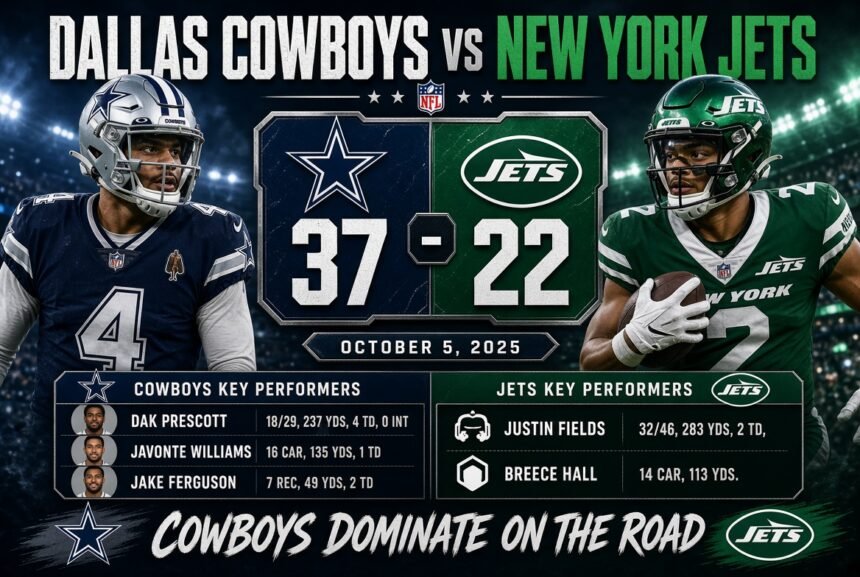
The most recent matchup between the Dallas Cowboys and the New York Jets took place on Sunday, October 5, 2025, during Week 5 of the NFL regular season at MetLife Stadium. Dallas came away with a 37-22 win that pushed the Jets to an 0-5 start, a result shaped by a costly fumble, four Dak Prescott touchdown passes, and a Jets offense that moved the ball well but couldn’t capitalize on its opportunities. Below is a full breakdown of the individual player stats from that game, sourced from Pro Football Reference, ESPN, CBS Sports, and both teams’ official recaps.
Final Score and Result
Dallas Cowboys 37, New York Jets 22. The win moved Dallas to 2-2-1 on the season (the Cowboys had an earlier Week 1 tie), while New York fell to 0-5, a difficult start compounded by a historically poor turnover-margin trend for the Jets defense.
Quarterback Passing Stats
Dak Prescott had an efficient night for Dallas, completing 18 of 29 passes for 237 yards and four touchdowns without an interception. His four touchdown passes were the headline offensive stat of the game and came against a Jets defense that, despite the final margin, kept things closer through the air than the score might suggest.
Justin Fields actually out-threw Prescott in raw yardage, going 32-of-46 for 283 yards with two touchdowns and zero interceptions. Fields’ higher completion volume reflects a Jets offense that moved the ball consistently between the twenties but struggled to finish drives with the same efficiency Dallas showed in the red zone.
Running Back Rushing Stats
Javonte Williams was the workhorse for Dallas, carrying the ball 16 times for 135 yards and a touchdown, the best rushing performance by either team on the day. His 5-yard touchdown run late in the first half was part of a critical two-score sequence for Dallas right before halftime.
Breece Hall had a strong all-around game for New York despite the loss, rushing 14 times for 113 yards and adding 4 receptions for 42 yards, giving him more than 150 yards from scrimmage. It was one of Hall’s best statistical performances of the young season, though it was overshadowed by a costly fumble discussed below.
Wide Receiver and Tight End Stats
Dallas found the end zone through the air twice via tight end Jake Ferguson, who caught 7 passes for 49 yards and 2 touchdowns, making him Prescott’s most productive target by both volume and scoring. George Pickens added a shorter but more explosive line, catching 2 passes for 57 yards and a touchdown, an average of over 28 yards per catch.
For the Jets, tight end Mason Taylor set a career high with 9 receptions for 67 yards, leading the team in catches. Garrett Wilson, targeted 10 times, caught 6 passes for 71 yards and a touchdown, giving New York a genuine receiving threat even in a losing effort.
Defensive Stats and Turnovers
Dallas’s pass rush had a strong day against Fields, recording sacks from James Houston (1.5), Dante Fowler (1.0), Sam Williams (1.0), and Osa Odighizuwa (0.5). There’s a minor discrepancy worth noting here: while individual credited sacks tallied to 4.0 in some box scores, the Jets’ own team-site recap described the total as 5 sacks allowed on Fields along with 14 quarterback hits, so the exact sack total varies slightly depending on the source consulted. New York’s lone recorded sack came from Braiden McGregor.
Neither team recorded an interception in this game, but a fumble proved decisive. Dallas linebacker Marist Liufau forced a fumble on a Breece Hall carry in the second quarter, and defensive end Sam Williams recovered it at Dallas’s own 10-yard line. That turnover triggered a 14-point swing, as Dallas scored twice in the final minute of the first half, first on Javonte Williams’ 5-yard touchdown run, then on a 1-yard Prescott-to-Ferguson touchdown pass with just 29 seconds left before halftime.
The Turnover That Changed the Game
Breece Hall was blunt in his postgame comments, calling his fumble “costly” and “unacceptable.” Jets head coach Aaron Glenn echoed that sentiment, specifically noting how the turnover reversed the game’s momentum at exactly the wrong time, just before halftime, when Dallas was able to convert the short field into 14 points in under a minute of game clock. That sequence effectively turned a competitive game into a two-score deficit that New York never fully closed.
A Historic Low Point for the Jets Defense
Beyond the box score from this specific game, the loss extended a larger and more unusual statistical trend: according to ESPN Research, cited by CBS Sports, the Jets became the first team in NFL history to go without a single takeaway through their first five games of a season since 1933, the year turnovers were first officially tracked. That context helps explain why, even with Justin Fields throwing for nearly 300 yards, New York’s overall record continued to slide.
Comparing the Two Team Performances
| Category | Dallas Cowboys | New York Jets |
|---|---|---|
| Final score | 37 | 22 |
| Passing yards | 237 (Prescott) | 283 (Fields) |
| Passing touchdowns | 4 | 2 |
| Leading rusher | Javonte Williams, 135 yds | Breece Hall, 113 yds |
| Turnovers forced (defense) | 1 | 0 |
| Team record after game | 2-2-1 | 0-5 |
The table highlights an important pattern: New York actually outgained Dallas through the air and had a strong individual rushing performance from Breece Hall, yet lost by 15 points. The turnover and Dallas’s red-zone efficiency, converting drives into touchdowns rather than field goals, made the difference far more than raw yardage did.
Injury and Roster Notes
Dallas linebacker Jack Sanborn suffered a concussion during the first half, a notable absence for the Cowboys’ defense as the game progressed. On a lighter note, the game featured a family storyline, with Jets rookie cornerback Azareye’h Thomas and Cowboys safety Juanyeh Thomas playing on opposite sidelines as professionals for the first time; Juanyeh Thomas finished with 9 tackles for Dallas.
Special Teams Notes
Jets kicker Nick Folk had a perfect night on field goals, including a 48-yard make, showing that New York’s special teams unit was performing well even as the offense and defense struggled to find complementary success. Those points kept the Jets within striking distance on the scoreboard for longer than the underlying game flow might have suggested.
What’s Next for Both Teams
At the time of this recap, the Jets were preparing to travel internationally for a game against Denver at Tottenham Hotspur Stadium in London the following week, adding a long-distance travel element to an already difficult stretch. For Dallas, the win offered a chance to build momentum with balanced offensive production, four touchdown passes to four different areas of the field along with a strong rushing performance, heading into the following weeks of the season.
Why Yardage Alone Didn’t Decide This Game
One of the more instructive aspects of this box score is how misleading total passing yardage can be as a standalone predictor of the outcome. Justin Fields out-threw Dak Prescott by 46 yards, yet Dallas won by 15 points. The explanation sits in two related areas: touchdown efficiency and turnover margin. Prescott’s four touchdown passes converted a similar number of drives into maximum points far more consistently than Fields’ two touchdowns did, and the single Hall fumble erased what would have otherwise been a promising Jets possession deep in Dallas territory. Anyone studying this game’s stat line for fantasy football or betting-model purposes should weight scoring efficiency and turnover margin at least as heavily as raw passing or rushing totals, since this particular result is a clear example of a team winning the yardage battle in one phase while still losing decisively overall.
Red Zone Execution as the Deciding Factor
A closer look at the scoring sequence shows Dallas converting short-field opportunities into touchdowns rather than settling for field goals, most notably the two scores in the final minute of the first half that followed directly from the forced fumble. Teams that consistently finish drives with touchdowns rather than field goals tend to win close statistical battles even when they don’t lead in every major category, and this game is a textbook example of that pattern. New York’s offense, by contrast, moved the ball well enough to rack up nearly 300 net passing yards but didn’t generate the same conversion rate once inside Dallas territory, a gap that shows up clearly in the final scoreline despite Fields’ respectable overall numbers.
Individual Performances Worth Tracking Going Forward
Beyond the immediate result, a few individual performances in this game are worth watching in the context of the rest of the season. Javonte Williams’ 135-yard, one-touchdown outing was one of his most productive games as Dallas’s lead back, a useful data point for anyone tracking his role in the offense going forward. On the Jets’ side, Breece Hall’s combined 155 rushing-and-receiving yards demonstrated his continued importance to New York’s offense even in a difficult team stretch, while Garrett Wilson’s touchdown reception on 10 targets reinforced his role as Fields’ primary downfield threat. Mason Taylor’s career-high 9 receptions likewise signaled a growing role in the passing game for the rookie tight end, a trend worth monitoring in subsequent Jets games.
A Note on Historical Context for the 0-5 Start
An 0-5 start with a defense that hadn’t forced a single takeaway is an unusually specific combination in modern NFL history, and it’s worth separating that broader trend from any single game’s stat line. This particular game contributed to that streak rather than being an outlier within it, since New York’s defense again failed to record either an interception or a fumble recovery against Dallas. Readers tracking season-long defensive trends should treat this game as one data point within a longer pattern rather than an isolated aberration.
Conclusion
The Dallas Cowboys defeated the New York Jets 37-22 in a Week 5 matchup on October 5, 2025, with Dak Prescott throwing four touchdown passes and Javonte Williams rushing for 135 yards. Justin Fields and Breece Hall both had productive statistical days for New York, but a second-quarter fumble by Hall swung 14 points toward Dallas right before halftime, and the Jets fell to an 0-5 start amid a historically poor turnover-margin trend on defense. All stats above are sourced from official box scores and verified sports data outlets listed below.
FAQ
1. What was the final score of the most recent Cowboys vs Jets game?
Dallas Cowboys 37, New York Jets 22, played on October 5, 2025, in Week 5 of the NFL season.
2. How many touchdown passes did Dak Prescott throw?
Dak Prescott threw four touchdown passes, completing 18 of 29 attempts for 237 yards with zero interceptions.
3. Who led the Jets in passing and rushing?
Justin Fields led New York in passing with 283 yards on 32-of-46 completions, while Breece Hall led in rushing with 113 yards on 14 carries.
4. What turnover changed the momentum of the game?
A second-quarter fumble by Breece Hall, forced by Dallas linebacker Marist Liufau and recovered by Sam Williams, led directly to 14 Dallas points before halftime.
5. How many sacks did Dallas record against Justin Fields?
Individual credited sacks totaled 4.0 in some box scores, though the Jets’ own team recap described the total as 5 sacks allowed; the exact number varies slightly by source.
6. Who caught the most touchdown passes in this game?
Jake Ferguson led all players with two receiving touchdowns, adding up to 7 receptions for 49 yards overall.
7. Where can I verify these stats independently?
Full box scores are available through Pro Football Reference, ESPN, CBS Sports, and both teams’ official websites, all linked in the sources section below.